The shoe has always been a cultural artefact. From the hand-stitched moccasin to the vulcanised rubber sole, every era of footwear design has told a story about the civilisation that produced it. In 2026, that story is one of deliberate, exuberant category collapse. Silhouette boundaries are dissolving. The binary distinctions that once separated athletic from elegant, casual from formal, utilitarian from ornamental — all of it is being consciously, gleefully dismantled. What has emerged from this creative demolition is one of the most exciting and commercially significant footwear phenomena in recent memory: the hybrid shoe.
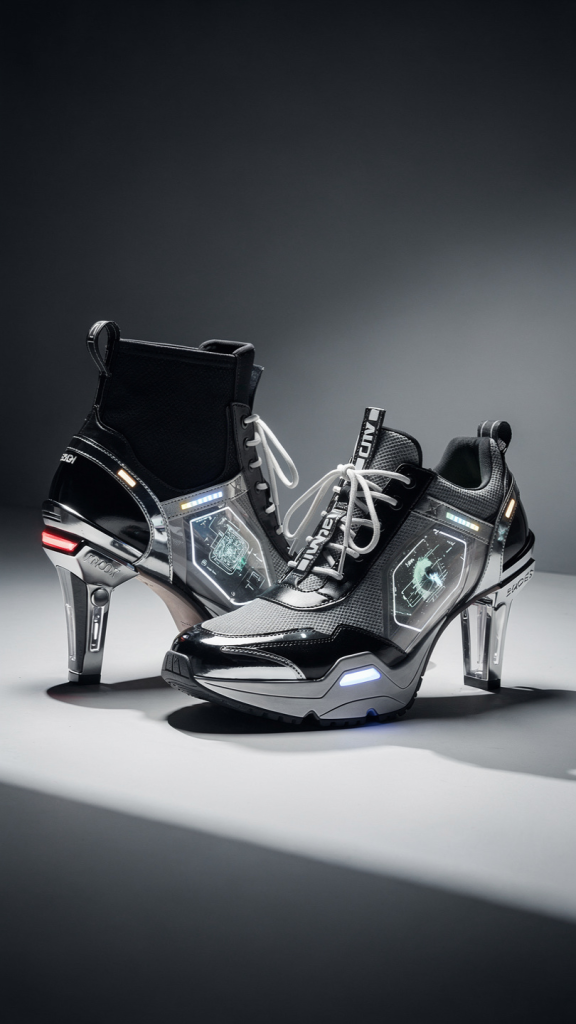
Hybrid Footwear Fashion 2026 is not a niche subcultural preoccupation. It has arrived, fully formed and runway-validated, in the collections of Bottega Veneta, Prada, Miu Miu, Chloé, Victoria Beckham, Calvin Klein, Celine, and beyond. It is on the feet of Jennifer Lawrence, Dua Lipa, and the most discerning street style attendees at every fashion capital. The data corroborates the visual evidence: fashion search platform Lyst reported searches for “ballet sneakers” surging by approximately 1,300% at the start of 2025, while StockX recorded sales of Mary-Jane-inspired sneakers rising by more than 350% year on year. The momentum has not waned. If anything, it has intensified.
This is what Hybrid Footwear Fashion 2026 looks like in practice, why it matters, and where it is heading.
The Conceptual Architecture of the Hybrid Shoe
Before cataloguing the specific silhouettes that are defining this moment, it is worth understanding what, precisely, constitutes a hybrid shoe and why the concept has found such fertile ground in the current fashion landscape.
At its most elemental, a hybrid shoe is a composite form — a footwear design that deliberately synthesises the visual or functional codes of two or more distinct shoe categories into a singular, unified object. The exercise is not one of pastiche or confused eclecticism. When executed with intelligence, the hybrid shoe creates something that neither of its constituent categories could achieve independently. It retains the recognition value of each source silhouette while generating a new aesthetic logic that transcends both.
The cultural conditions enabling this creative promiscuity are worth acknowledging. Fashion has been experiencing what commentators describe as a shift away from the quiet luxury era into a period defined by nostalgia, layering, and the playful juxtaposition of opposing registers. The return of the “skouser” — a trouser-skirt hybrid — and the widespread embrace of the “scoat” — a scarf worn as a coat — from Toteme and others signalled that apparel was already moving in this direction. Footwear, characteristically, has followed with particular gusto.
Consumers, meanwhile, have arrived at a long-overdue rejection of the false dichotomy between comfort and sophistication. The pandemic-era capitulation to maximum informality has been succeeded not by a return to discomfort in the name of elegance, but by a collective demand for both simultaneously. The hybrid shoe is, in this sense, the most honest and practical response to how contemporary people actually live.
The Sneakerina and the Mary-Jane Trainer: Frankenshoes for a New Era
No single hybrid silhouette has generated more cultural heat in Hybrid Footwear Fashion 2026 than the sneakerina — a portmanteau that captures its essential nature with disarming precision. Part ballet flat, part sneaker, occasionally incorporating the strap architecture of a Mary Jane, this “Frankenshoe” has moved from runway novelty to certified wardrobe staple in what fashion cycles measure as record time.
The Mary-Jane trainer variant represents perhaps its most commercially potent expression. Adidas’s Samba Jane — the coveted Samba silhouette equipped with a feminine dorsal strap to create a Mary-Jane sensibility — has proven a particular phenomenon, with Nike, Vans, Miu Miu, Marni, and Louis Vuitton all producing their own interpretations of the strapped sneaker grammar. Kim Kardashian’s collaboration with Nike on a SKIMS version of the Rift has brought the silhouette to an audience that extends well beyond the traditional sneaker cognoscenti.
Chloé’s contribution deserves particular mention. Under creative director Chemena Kamali, the house debuted the Kick — a trainer that synthesises the visual language of ballet with the structural sensibility of a boxing shoe — as Kamali’s inaugural footwear offering. The effect is startling and wholly coherent: feminine and combative simultaneously, a shoe that looks as comfortable on a parquet floor as in a gymkhana. It is precisely the kind of design that crystallises what makes Hybrid Footwear Fashion 2026 so compelling as a cultural phenomenon. The best hybrids don’t merely combine; they synthesise, producing forms with their own internal logic and identity.
Mary Jane and ballet-inspired trainers also made conspicuous appearances on the Prada and Miu Miu runways for Spring/Summer 2026, their delicate straps and rounded toes set upon practical athletic soles — an effortless method of introducing femininity into daily dressing without sacrificing a single iota of functionality.
Loafer Mules and the Luxe Casualwear Convergence
If the sneakerina represents the playfully subversive end of the Hybrid Footwear Fashion 2026 spectrum, the loafer mule occupies its more refined, quietly elegant register. And it is making an emphatic case for itself as the season’s most enduring hybrid proposition.
The synthesis here is between two of the most trusted silhouettes in modern footwear — the heritage loafer, with its connotations of Ivy League polish and Continental insouciance, and the mule, that most effortlessly chicane of all backless constructions. The resulting amalgam provides the structural front presence and intellectual authority of a traditional loafer while the absence of a heel counter introduces an ease of movement and a certain louche sophistication that neither category possesses alone.
Bottega Veneta, Victoria Beckham, Calvin Klein, and Celine have all incorporated the loafer mule into their Spring/Summer 2026 collections, which amounts to an institutional benediction. These are not brands that chase trends; they are brands that, when they collectively embrace a silhouette, are recognising something that has already achieved critical mass in the broader cultural conversation. Set upon cushioned soles — lightweight EVA or springy foam underfoot lending athletic responsiveness to an otherwise aristocratic form — the loafer mule positions itself as the anti-orthopaedic comfort shoe: easy elegance rather than medical pragmatism.
The Kitten-Heel Ballet Flat: Elevation Without Sacrifice
Another hybrid configuration that has achieved genuine traction in Hybrid Footwear Fashion 2026 is the kitten-heel ballet flat — a silhouette that may initially appear like a contradiction in terms, but which, on closer inspection, reveals a sophisticated internal logic.
The traditional ballet flat’s relationship with the ground is complete. Zero elevation, maximum groundedness, a proximity to the earth that communicates either avant-garde minimalism or sartorial effortlessness depending on context. The kitten heel, by contrast, introduces a whisper of verticality — not enough to alter posture dramatically, but sufficient to lengthen the silhouette and reintroduce a note of Parisian formality that the flat categorically refuses. When these two principles are fused, the result is a shoe that maintains the French-coded delicacy of the ballet flat while acquiring just enough architectural complexity to function across a broader range of sartorial registers.
Fashioned in a backless mule configuration, this hybrid achieves maximum versatility. Paired with balloon pants, tailored cigarette trousers, or even a column dress, kitten-heel ballet mules have rapidly become the choice of the considered dresser — those for whom “trend” is only worth pursuing insofar as it aligns with something deeper and more enduring in their personal aesthetic vocabulary.
Dress Sneaker Hybrids: The End of the Office-Casual Binary
In menswear, Hybrid Footwear Fashion 2026 has found one of its most commercially consequential expressions in the dress sneaker hybrid. This is not a new concept in its broadest contours — the “smart casual” shoe has existed in various forms for some time — but the current iteration is unprecedented in its design ambition and material refinement.
The formula is deceptively simple: Oxford or Derby uppers, executed in premium nubuck, suede, or leather, married to athletic midsoles that provide the cushioning and propulsive responsiveness previously available only in technical footwear. The result is a shoe that can genuinely traverse the spectrum from formal conference room to weekend restaurant without the wearer performing any conscious category violation.
Bergdorf Goodman’s senior fashion director notes that their customer continues to seek comfort and convenience within the context of quality and craftsmanship, gravitating toward what the industry has begun calling “hybrid style shoes” — Loro Piana’s Summer Walk being a paradigmatic example, alongside a proliferating category of leather and suede loafers with flexible soles and softened uppers. The Mytheresa menswear buying director observes an emerging hybrid influence in the smarter end of the runner category — slimmer, low-profile silhouettes with elevated materials like suede, satin, and washed textures that feel more considered than overtly technical.
The minimalist heritage sneaker, meanwhile, is completing a parallel journey from athletic category to elevated lifestyle object, its clean lines and deliberately restrained palette positioning it as a companion piece to tailored separates rather than purely to sportswear.
Material Innovation and the Sustainable Imperative
No comprehensive account of Hybrid Footwear Fashion 2026 can responsibly omit the material and ecological dimensions of this trend. The hybridisation of shoe forms is occurring in parallel with — and is in many ways enabled by — extraordinary innovations in footwear materials science.
Bio-leather derived from non-food-grade corn and recycled textiles, recycled ocean plastics reformulated into premium-feeling uppers, responsibly sourced suedes processed without heavy-metal tanning agents — these are not niche offerings from peripheral sustainable brands. They are being incorporated into the material vocabularies of mainstream and luxury labels alike, responding to a consumer base that increasingly assesses fashion purchases through an environmental lens.
Textural pluralism is another hallmark of the current moment. Soft satins, faux shearling and shaggy faux-fur finishes, washed textures and eel-print embossments — these surfaces are appearing across hybrid silhouettes from Dries Van Noten, Gucci, and Chloé, transforming the shoe from a purely structural object into something approaching textile sculpture. The hybrid shoe is, in this sense, performing a double synthesis: simultaneously merging forms and merging surfaces, compounding its visual complexity and its claim on the wearer’s attention.
Technical narrow fabrics — reflective jacquard elastic loops, adjustable nylon webbing with quick-release hardware, scrunchie-style ruched elastic straps — introduce athletic functionality into traditionally formal constructions and outdoor utility into luxury sandal architecture. The vocabulary of the trail runner and the language of the couture atelier are, quite literally, being stitched together.
The Consumer Psychology Behind the Hybrid Movement
Understanding why Hybrid Footwear Fashion 2026 has resonated so deeply with contemporary consumers requires a brief excursus into the psychology of current purchasing behaviour.
The hybrid shoe functions as a remarkably efficient wardrobe instrument. A single pair of Mary-Jane trainers collapses what would otherwise require two separate purchases — a polished flat for structured occasions, an athletic trainer for active days — into a single object of genuine versatility. In an era of wardrobe rationalisation and growing resistance to fast-fashion overconsumption, this efficiency argument is not merely pragmatic; it is morally appealing.
There is also something psychologically complex at play in the hybrid shoe’s capacity to signal simultaneous membership of multiple cultural tribes. The wearer of a sneakerina is neither wholly devoted to the ballet-flat aesthetic nor entirely committed to the trainer culture; they are occupying a more fluid, polysemous identity position that feels authentically contemporary in a world where rigid categorical identity is increasingly regarded with suspicion.
Fashion insiders observe that hybrid silhouettes are serving as gateway products for younger consumers entering luxury brands for the first time, with the hybrid trainer representing many such consumers’ initial luxury purchase. This generational recruitment function is not lost on the major houses.
Where the Hybrid Trajectory Leads
The arc of Hybrid Footwear Fashion 2026 points not toward saturation but toward further elaboration. As designers grow more confident in their capacity to synthesise disparate shoe taxonomies, the combinations being explored will inevitably become more unexpected, more conceptually ambitious, and more technically demanding to realise.
The tech-utility boot — a hiking or work-boot silhouette injected with the construction methods and cushioning architectures of high-performance athletic footwear — represents one frontier. The continued evolution of the sneakerina toward more balletic and sculptural forms represents another. Western-boot silhouettes rendered in summer-appropriate washed buffalo leathers and muted sand suedes, designed to bridge seasonal categories with the same conceptual fluidity that other hybrids bridge functional ones, suggest a third trajectory.
What will not change is the underlying philosophical proposition that makes Hybrid Footwear Fashion 2026 so resonant: that the most honest and interesting footwear design happens not within categories but between them. The hybrid shoe does not ask its wearer to choose between comfort and elegance, between the athletic and the refined, between the nostalgic and the contemporary. It refuses the premise of the choice entirely.
In a broader cultural landscape still learning to hold complexity and contradiction without defaulting to false binaries, that refusal feels less like a trend and more like a posture. A way of standing in the world. Quite literally.
You may also like
-
The Multidimensional Framework of **Precision Mens Haircut**: A Data-Driven Analysis of Artistry, Industry Evolution, and Consumer Demand in 2024
-
The Systematic Advancement of Premium Barbering Tools: A Multidimensional Analysis of Innovation, Industry Standards, and Consumer Demand
-
The Groomed Mind: Behavioral Science, Societal Feedback, and the Strategic Calibration of Men’s Confidence and Presentation Across Contexts
-
The Comprehensive Framework of **Alpha Grooming Rituals**: Industry Standards, Technological Integration, and the Cultural Shift Toward Masculine Self-Care in 2024
-
The Strategic Blueprint of Men’s Wardrobe Intentionality: A Multidimensional Analysis of Style, Confidence, and Societal Perception in Modern Contexts