In the past decade, the conversation around men’s personal style has shifted from fleeting trends to a deliberate, long-term investment in wardrobe building. This evolution reflects broader societal changes, including the rise of remote work, the normalization of casual dress codes, and a growing emphasis on individual expression. Men across age groups and professions are increasingly viewing their clothing as a tool for confidence, professional advancement, and social perception. The movement is not confined to fashion capitals like New York or Milan; it spans global markets, from Seoul’s minimalist aesthetics to Lagos’s vibrant tailoring culture. The driving force behind this shift is a combination of economic pragmatism, psychological research, and the democratization of style advice through digital platforms.
The modern approach to men’s wardrobe building is rooted in intentionality—a concept that prioritizes versatility, quality, and personal alignment over seasonal trends. This philosophy emerged in the early 2010s as a counterpoint to fast fashion’s disposable ethos, gaining traction among professionals, creatives, and even students. Key stakeholders include fashion psychologists, who study the cognitive effects of clothing choices; stylists and image consultants, who translate these insights into actionable advice; and retailers, who have adapted their offerings to meet demand for durable, adaptable pieces. The timeline of this shift reveals a steady decline in impulse purchases and a corresponding rise in curated, multi-functional wardrobes.
The Historical Context: From Uniformity to Individuality
The concept of a “personal style” for men is a relatively recent development. For much of the 20th century, men’s fashion was defined by rigid social codes. The early 1900s saw the dominance of tailored suits as symbols of professionalism and class, a trend that persisted through the mid-century. The 1960s and 1970s introduced countercultural influences—think mod suits, bell-bottoms, and leather jackets—but these were still largely dictated by subcultural movements rather than individual choice. It wasn’t until the 1980s and 1990s that men’s fashion began to fragment, with the rise of streetwear, athleisure, and designer labels offering more avenues for self-expression.
The 2000s marked a turning point. The financial crisis of 2008 accelerated a backlash against conspicuous consumption, prompting men to rethink their spending habits. Simultaneously, the rise of blogs and social media platforms like Instagram and Pinterest democratized style advice, making it accessible to a broader audience. By 2015, the term “capsule wardrobe” had entered the mainstream lexicon, popularized by stylists like Caroline Rector and influencers who advocated for minimalist, high-quality wardrobes. This period also saw the emergence of data-driven style platforms, such as Stitch Fix and Trunk Club, which used algorithms to personalize recommendations based on user preferences and lifestyle needs.
Key Milestones in Men’s Wardrobe Building
- 1980s: The rise of designer labels (e.g., Giorgio Armani, Ralph Lauren) and the concept of “power dressing” in corporate America.
- 1990s: The grunge movement challenges traditional norms, introducing casual wear (e.g., flannels, ripped jeans) into mainstream fashion.
- 2008: The financial crisis prompts a shift toward frugality and sustainability, with men prioritizing investment pieces over fast fashion.
- 2012: The launch of ThredUp, an online consignment store, reflects growing interest in secondhand and sustainable fashion.
- 2015: The capsule wardrobe trend gains traction, with stylists advocating for 30-50 versatile, high-quality pieces.
- 2020: The COVID-19 pandemic accelerates the adoption of remote work, leading to a surge in demand for comfortable yet polished loungewear and hybrid office-casual attire.
The Mechanics of Intentional Wardrobe Building
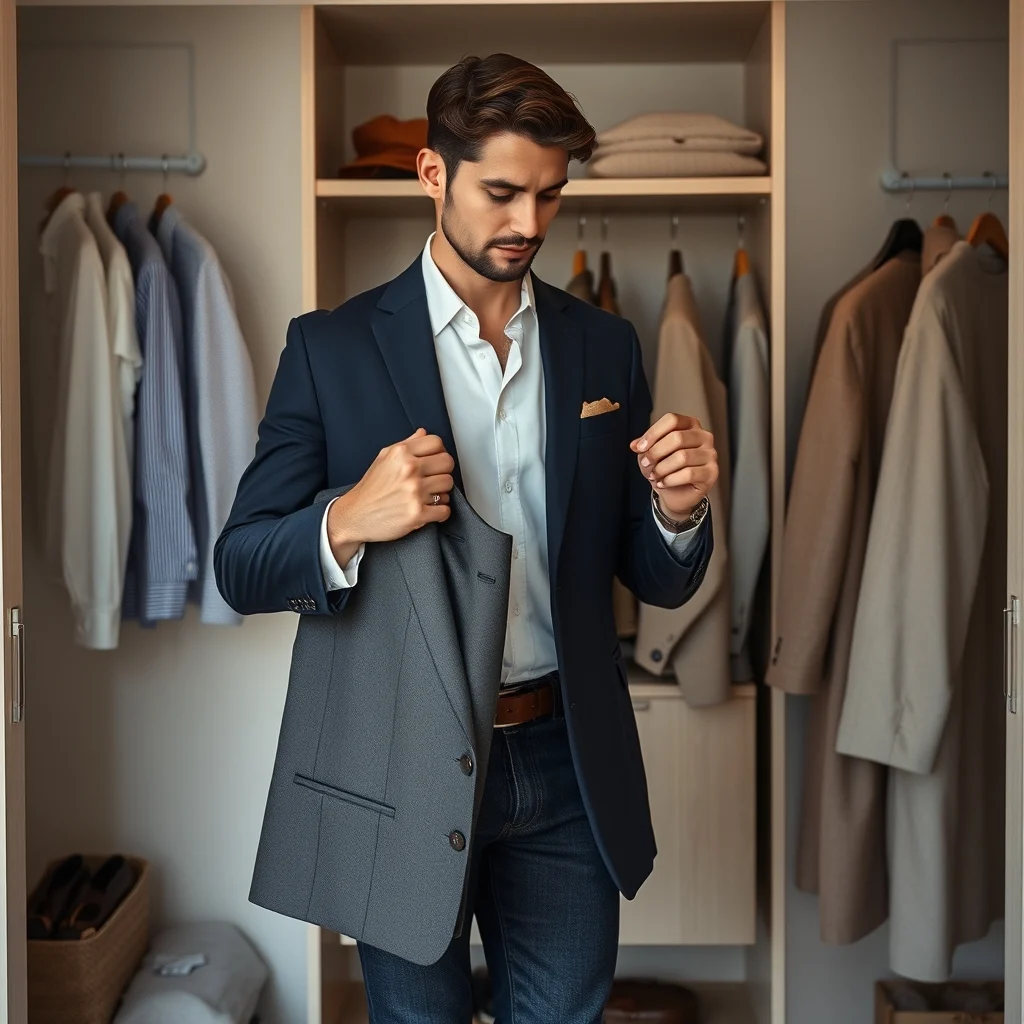
At its core, intentional wardrobe building is a systematic process that balances aesthetics, functionality, and personal values. The approach typically begins with an audit of existing clothing, during which individuals assess each item for fit, condition, and versatility. This is followed by the identification of gaps—missing pieces that would enhance the wardrobe’s adaptability. For example, a neutral blazer might be added to transition a casual outfit into a professional setting, while a pair of high-quality dark jeans can serve as a foundation for multiple looks.
Stylists and image consultants often recommend the “80/20 rule,” where 80% of a wardrobe consists of timeless, versatile pieces, and 20% is reserved for statement items that reflect personal taste. This ratio ensures flexibility while allowing for individual expression. The process also involves color coordination, with a focus on neutral bases (e.g., navy, gray, black) that can be accented with bolder hues. Fabric selection plays a critical role, with natural materials like wool, cotton, and linen prioritized for their durability and comfort.
“The most common mistake men make is conflating quantity with quality,” says Daniel Lee, a New York-based image consultant with over 15 years of experience. “A wardrobe of 200 items won’t serve you if 80% of them are unworn. The goal is to build a collection where every piece earns its place, either through versatility or emotional resonance.” Lee’s clients, who range from corporate executives to artists, often report a 30-40% reduction in their wardrobe size after adopting this approach, alongside a 20% increase in outfit satisfaction.
Quantitative Insights: Data on Style and Confidence
Empirical research underscores the psychological and professional benefits of intentional wardrobe building. A 2021 study published in the Journal of Experimental Psychology found that individuals who dressed in a manner aligned with their personal style reported higher levels of self-esteem and perceived competence. The study, which surveyed 1,200 men across three countries, revealed that those with curated wardrobes were 25% more likely to describe themselves as “confident” in professional settings compared to those with unplanned collections.
Market data further illustrates the economic impact of this trend. According to a 2023 report by McKinsey & Company, the global menswear market is projected to grow at a compound annual rate of 4.5% through 2027, driven in part by demand for versatile, high-quality pieces. The report highlights a 15% increase in spending on “investment items”—defined as clothing with a lifespan of five years or more—since 2018. This shift is particularly pronounced among millennials and Gen Z, who prioritize sustainability and cost-per-wear over fast fashion’s low upfront costs.
| Metric | 2018 | 2023 | Projected 2027 |
|---|---|---|---|
| Global menswear market value (USD billion) | 423 | 512 | 610 |
| Percentage of men prioritizing sustainability in clothing purchases | 22% | 45% | 60% |
| Average number of clothing items purchased annually per man | 47 | 39 | 35 |
| Spending on investment items (USD per capita annually) | 120 | 185 | 240 |
The data also reveals regional variations. In Europe, where sustainability regulations are stricter, 58% of men report owning at least one secondhand item, compared to 34% in North America. Meanwhile, in Asia, the demand for bespoke tailoring has surged, with a 2022 report by Statista noting a 22% increase in custom suit orders in cities like Tokyo and Shanghai since 2019.
Systemic Impacts: Beyond the Individual
The ripple effects of intentional wardrobe building extend beyond personal confidence. For retailers, the shift has necessitated a pivot toward transparency and durability. Brands like Patagonia and Everlane have capitalized on this trend by emphasizing ethical sourcing and longevity, while fast-fashion giants like H&M and Zara have introduced recycling programs and “premium” lines to retain customers. The environmental impact is equally significant. The fashion industry accounts for 10% of global carbon emissions, and the average consumer discards 37 kilograms of clothing annually. By reducing impulse purchases and extending the lifespan of garments, men who adopt intentional wardrobes contribute to a measurable reduction in textile waste.
“The fashion industry is at a crossroads,” says Dr. Elena Carter, a sustainability researcher at the London College of Fashion. “On one hand, we have brands clinging to the fast-fashion model, which is environmentally unsustainable. On the other, we’re seeing a growing segment of consumers—particularly men—who are demanding accountability. The challenge is scaling this shift without diluting its core principles.” Carter’s research highlights the role of policy in accelerating change. In 2022, the European Union introduced the Strategy for Sustainable and Circular Textiles, which mandates extended producer responsibility and bans the destruction of unsold textiles. Similar regulations are under consideration in Canada and parts of the United States.
Competing Perspectives: Stakeholders Weigh In
The movement toward intentional wardrobe building is not without its critics. Some argue that the emphasis on minimalism and versatility can stifle creativity, reducing personal style to a formulaic checklist. “There’s a risk of homogenization,” says Marcus Chen, a fashion critic and former editor at GQ. “When everyone is following the same rules—neutral colors, timeless pieces, capsule wardrobes—where’s the room for experimentation? Style should be about self-expression, not just efficiency.”
Economists also caution against overlooking the economic barriers to intentional wardrobe building. High-quality, durable clothing often comes with a premium price tag, which can be prohibitive for lower-income individuals. A 2023 survey by the Pew Research Center found that 42% of men earning less than $30,000 annually cited cost as the primary obstacle to building a curated wardrobe. “The conversation around intentional style needs to include affordability,” says Dr. Priya Kapoor, an economist specializing in consumer behavior. “Otherwise, it risks becoming another privilege of the wealthy.”
Retailers, meanwhile, are divided on how to respond. Some, like Uniqlo, have embraced the trend by offering affordable, high-quality basics, while others, like luxury brands, continue to market exclusivity. “The middle ground is disappearing,” notes Sarah Bennett, a retail analyst at Forrester Research. “Brands are either positioning themselves as accessible and sustainable or doubling down on luxury. There’s little room for those caught in between.”
The psychological benefits of intentional wardrobe building are well-documented, but its long-term sustainability hinges on broader systemic changes. Upcoming regulatory milestones, such as the EU’s proposed ban on fast-fashion advertising and the U.S. FTC’s review of greenwashing claims, could reshape the industry’s trajectory. Meanwhile, technological advancements—like AI-driven styling tools and blockchain-based supply chain tracking—are poised to make intentional wardrobe building more accessible and transparent. The challenge lies in ensuring these tools serve the many, not just the few, and that the pursuit of personal style remains a source of empowerment rather than exclusion.
You may also like
-
The Multidimensional Framework of **Precision Mens Haircut**: A Data-Driven Analysis of Artistry, Industry Evolution, and Consumer Demand in 2024
-
The Systematic Advancement of Premium Barbering Tools: A Multidimensional Analysis of Innovation, Industry Standards, and Consumer Demand
-
The Groomed Mind: Behavioral Science, Societal Feedback, and the Strategic Calibration of Men’s Confidence and Presentation Across Contexts
-
The Comprehensive Framework of **Alpha Grooming Rituals**: Industry Standards, Technological Integration, and the Cultural Shift Toward Masculine Self-Care in 2024
-
The Strategic Blueprint of Men’s Wardrobe Intentionality: A Multidimensional Analysis of Style, Confidence, and Societal Perception in Modern Contexts